Advanced Diagnostic & Interventional Radiology Research Center | ] Prediction of hepatocellular carcinoma response to transarterial chemoembolization with intravoxel incoherent motion diffusion weighted imaging
Advanced Diagnostic & Interventional Radiology Research Center | ] Prediction of hepatocellular carcinoma response to transarterial chemoembolization with intravoxel incoherent motion diffusion weighted imaging
| Dec 11 2025
logo

Advanced Diagnostic & Interventional Radiology Research Center

COVID-19 pandemic 

During the COVID-19 pandemic, the Radiology Research Center at Tehran University of Medical Sciences continued its research activities despite the challenges posed by the increased demand for CT scans of COVID-19 patients and the necessity of adhering to strict health protocols. This center played a crucial role in improving medical imaging techniques, optimizing diagnostic protocols, and advancing technologies related to CT scan image analysis.

Faculty members, researchers, and staff remained committed to ensuring the safety and well-being of healthcare professionals and patients while actively engaging in imaging data analysis, developing artificial intelligence algorithms for faster disease detection, publishing scientific articles, and presenting their findings at international conferences. These efforts aimed to enhance diagnostic accuracy, improve treatment processes, and alleviate pressure on healthcare systems.


Key achievements of the Radiology Research Center during the COVID-19 pandemic include:


✔️ Development and optimization of lung imaging protocols for faster and more accurate COVID-19 diagnosis
✔️ Implementation of artificial intelligence technologies for automated CT scan analysis and reduced diagnosis time
✔️ Publication of high-impact research articles on innovative imaging methods for COVID-19 patients
✔️ Participation in national and international projects focused on COVID-19 diagnosis and patient management

The center remains dedicated to advancing research in medical imaging and continues to contribute as a leading scientific institution in improving the quality of diagnostic and therapeutic services.


Some of the center's significant achievements during the pandemic include:


  • Release Date : Jul 24 2024 - 09:30
  • : 142
  • Study time : 1 minute(s)

] Prediction of hepatocellular carcinoma response to transarterial chemoembolization with intravoxel incoherent motion diffusion weighted imaging

hepatocellular carcinoma response to chemoembolization with diffusion mri {faces}

Background

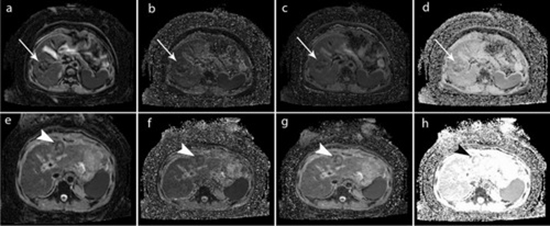
There are several therapeutic options for hepatocellular carcinoma (HCC). As predicting the treatment response is critical in clinical decision making, we aimed to evaluate the quantitative intravoxel incoherent motion (IVIM) diffusion-weighted imaging (DWI) parameters as potential predictors of treatment response of HCC lesions to transarterial chemoembolization (TACE).

Results

Twelve patients (eight males; mean age, 56.12 ± 7.88) with 26 confirmed HCC lesions were recruited in the study. Thirteen lesions (50%) responded to TACE, and the remaining lesions were categorized as nonresponder. Age > 60 year (p value: 0.018), D (p value: 0.005), D* (p value: 0.005), and f (p value: 0.004) values were significantly different in response and nonresponse group lesions. Logistic multivariate analysis showed that f value (OR: 0.847 (95% CI 0.732–0.98), p value = 0.025) could independently predict tumor response to TACE. The ROC curve analysis showed f value could predict the HCC response to TACE with sensitivity and specificity of 76.9% and 76.9%, respectively.

Conclusions

IVIM-DWI parameters, especially the f value, might be useful for predicting the response of the intermediate-stage HCC to TACE.

  • Article_DOI :
  • Author(s) :
  • News Group : research,articles,research article,AI,AI articles
  • News Code : 277924
مدیر سایت
Author:

مدیر سایت

0 Comments for this article

comment

Post your comment:

متن درون تصویر را در جعبه متن زیر وارد نمائید *
Enter your desired term to search
Theme settings